


A law firm website can look modern and completely up to date while still producing very few enquiries. That’s because visual design alone rarely converts visitors. Potential clients need clear information, reassurance, and an easy path to contact your firm before they’re ready to take that step.
The good news is that improving website performance doesn’t always require a complete rebuild. Often, the difference comes down to clearer messaging, stronger trust signals, and a simpler enquiry process. This guide explores the elements that help legal websites attract and convert more prospective clients.
But first, let’s look at why so many law firm websites fall short in the first place.
Most law firm websites don’t generate enquiries because they focus more on how the site looks than on the visitor. The pages talk about the firm’s history, the lawyers’ credentials, and the services offered. But they rarely answer the one question a visitor is actually asking: “Can you help me with my problem?”
When a website fails to answer that question quickly, visitors leave. Every missed opportunity increases bounce rates and reduces the likelihood of an enquiry. Even a professional-looking website will struggle to perform if potential clients can’t immediately understand what the firm does, who it helps, and why they should get in touch.
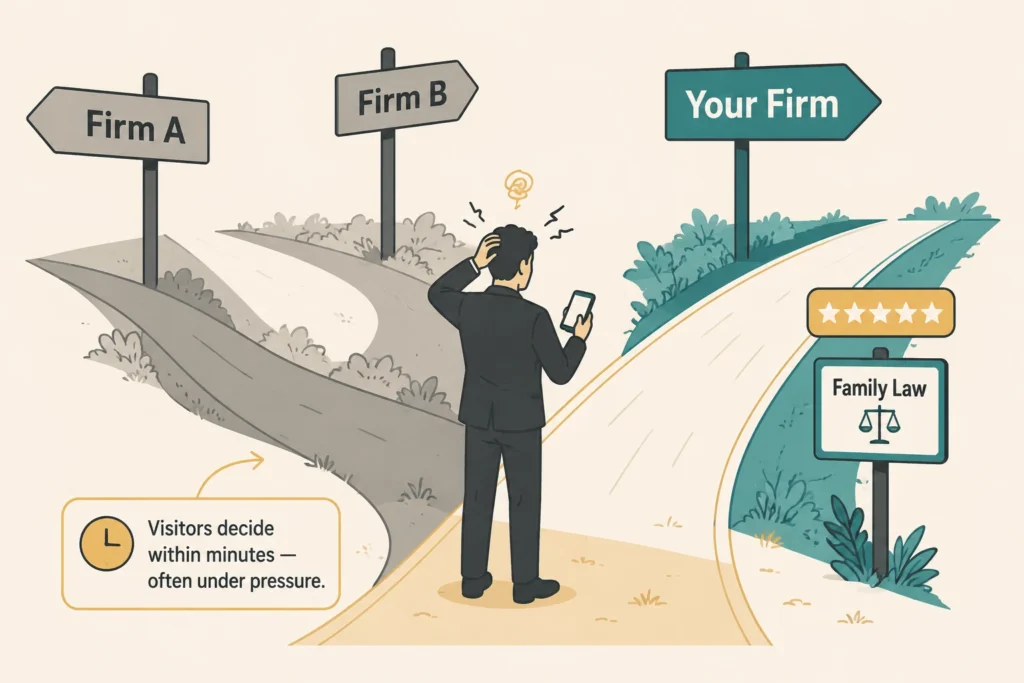
Legal web design differs from most other business websites because visitors are often under pressure when they land on your site. They may be dealing with a dispute, an injury, or a family breakdown, and they’re deciding within minutes whether your firm is worth contacting.
That decision is heavily influenced by how the site looks and feels. A Stanford credibility study found that 46.1% of consumers judge a website’s credibility on visual design alone, including layout, typography, and colour schemes. When potential clients are comparing multiple firms, a site that looks outdated or difficult to navigate can quickly fall behind.
Knowing how to design a good web page is a useful starting point. Legal websites carry additional demands, though.
After all, building trust with a stressed, high-stakes client takes more than good visuals. The site also needs to communicate credibility, demonstrate expertise, and provide a clear next step.
Most law firm sites we come across have five or six pages, sometimes more, but only four of them actually influence whether someone reaches out. The rest is filler nobody clicks on. So, before you touch fonts or colours, these are the pages worth getting right.
Your home page has one job: make it clear that they’re in the right place. They have plenty of other options, so if the message isn’t clear within the first few seconds, they’ll leave for a competitor.
One of the best ways to prevent that is by showing what you do and where, specifically. That means your practice areas, location, and services need to be front and centre before the visitor even scrolls.
Think about it from the client’s side. If you landed on a law firm’s website and saw a 4.9-star Google rating with hundreds of reviews, you’d probably stick around. That’s why testimonials, professional credentials, and bar memberships appear so frequently on legal websites. They help reassure visitors that they’re dealing with an established, credible firm.
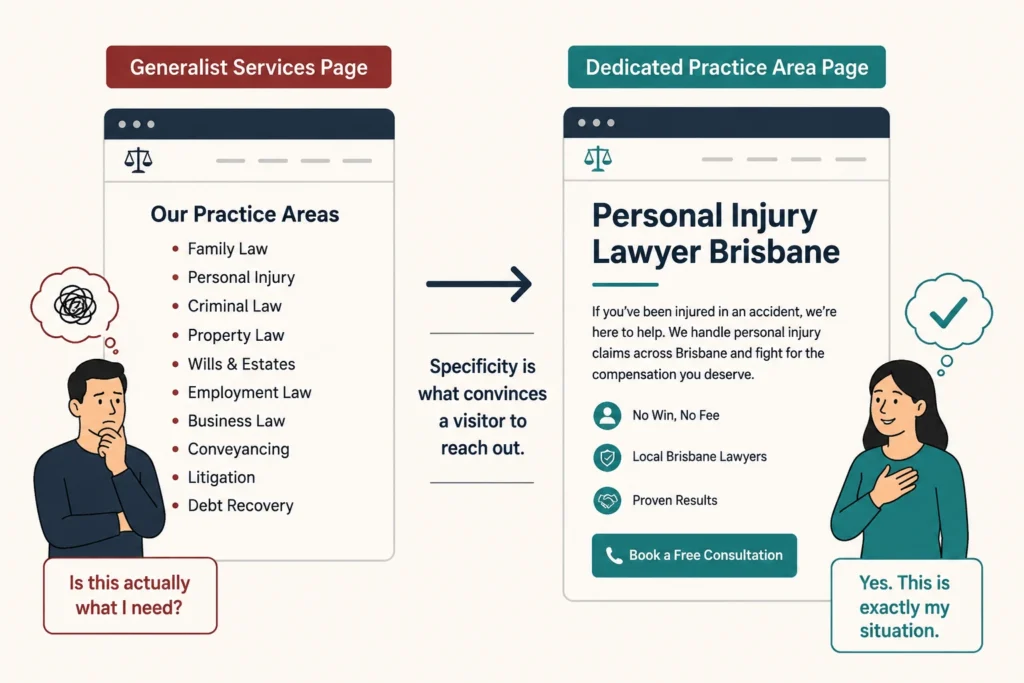
Each practice area deserves its own dedicated page. Someone searching for a personal injury lawyer wants to see that you handle personal injury cases specifically. They don’t want another generalist who “also” does that.
Once they land on the page, they should immediately see that you’ve helped people facing the same problem. The content itself needs to show that. A plain language explanation of the legal issue, what the process typically involves, and the concerns most people have at that stage all help build that picture.
For lawyer websites, that level of specificity is often what convinces a visitor to reach out.
People hire lawyers, not firms. Before a potential client picks up the phone, they’ll often look up the lawyer they’d be working with. That means your bio pages can directly influence whether someone decides to reach out.
A bio should open with what the lawyer actually does for clients and the types of cases they handle. Relevant experience, professional memberships, and a photo then help establish credibility and make the lawyer feel more approachable.
Once that trust is established, end each bio with a direct call to action, because a visitor who’s ready to reach out shouldn’t have to go looking for a way to do it.
The contact page is where enquiries either happen or don’t. A user-friendly contact page gives visitors exactly what they need at that moment: your phone number, a contact form, and a physical address with a map. If those details are hard to find or the form asks too much upfront, potential clients may leave before making contact.
The same principle applies across other professional service websites, including dental web design. A contact page that feels like extra work suggests working with your firm will be, too. So keep the process simple and make every path to contact easy to find.
A beautifully designed website won’t generate enquiries if nobody finds it. SEO and web design aren’t separate projects because they’re built on the same foundation. Site structure, page speed, mobile responsiveness, and clean navigation all affect how Google crawls and ranks your site.
Practice area pages play an important role in that structure. When built correctly, they can become some of your strongest SEO assets. Each page targets a specific search term, such as “personal injury lawyer Brisbane,” while still providing useful information to potential clients.
Skip these fundamentals, and you’ll end up with a site that looks great but stays buried on page two, where most potential clients will never find it.
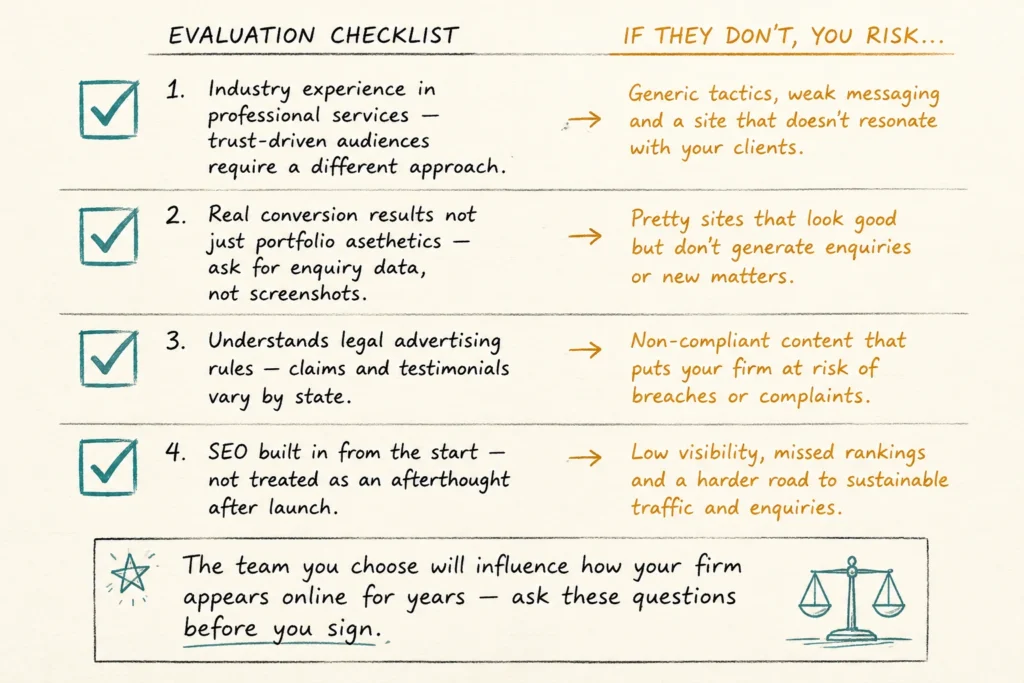
Not every web design agency is equipped to build a site that generates legal enquiries. The difference shows up quickly when you ask the right questions before signing anything.
Here’s what to look for while researching a provider:
The team you choose will influence how your firm appears online for years. So take the time to ask these questions upfront, and you’ll avoid the cost of fixing a site that was never built to perform.
A typical law firm website redesign follows a similar path regardless of which agency you choose. It starts with discovery, understanding your practice areas, target clients, and the current site’s weaknesses. From there, the provider moves into wireframing and content planning before any design work beginning.
Design and copywriting come next, followed by development and testing across devices. Once the site is live, a good agency will monitor performance and fix any issues that emerge during the transition. This often includes a short overlap period as they retire your old site.
The entire process typically takes between 6 and 12 weeks, depending on the number of practice areas and pages involved.
A law firm website redesign works best when you treat it as a client-acquisition project rather than a branding refresh. So before you start, gather your existing content, decide which practice areas need dedicated pages, and set a realistic budget based on the scope above.
The firms that see the strongest increase in enquiries are the ones that fix the fundamentals first: clear messaging, trust signals, and low-friction contact paths. Once those are in place, everything else becomes easier to build on, including SEO, content, and ongoing updates.
And if you’re not sure where your current site is falling short, DevelopersDex offers a free website review for law firms. We’ll identify the gaps and give you a clearer picture of what needs improving. Get in touch for your free review.
Company Reviews