

The quickest way to increase your website conversion rate is to stop sending traffic to a site that isn’t built to convert it. That means your design, your copy, and your calls to action need attention before anything else does.
And when those elements aren’t working together, every campaign you run delivers less than it should. That’s the conversion problem most Brisbane businesses are sitting on right now.
We’ve helped a lot of Brisbane businesses work through this problem. This comprehensive guide covers benchmarks, design decisions, calls to action, and testing, so you have a clear path to better lead generation results.
Let’s get into it.
The first question most beginners ask is, “What is a good website conversion rate?”
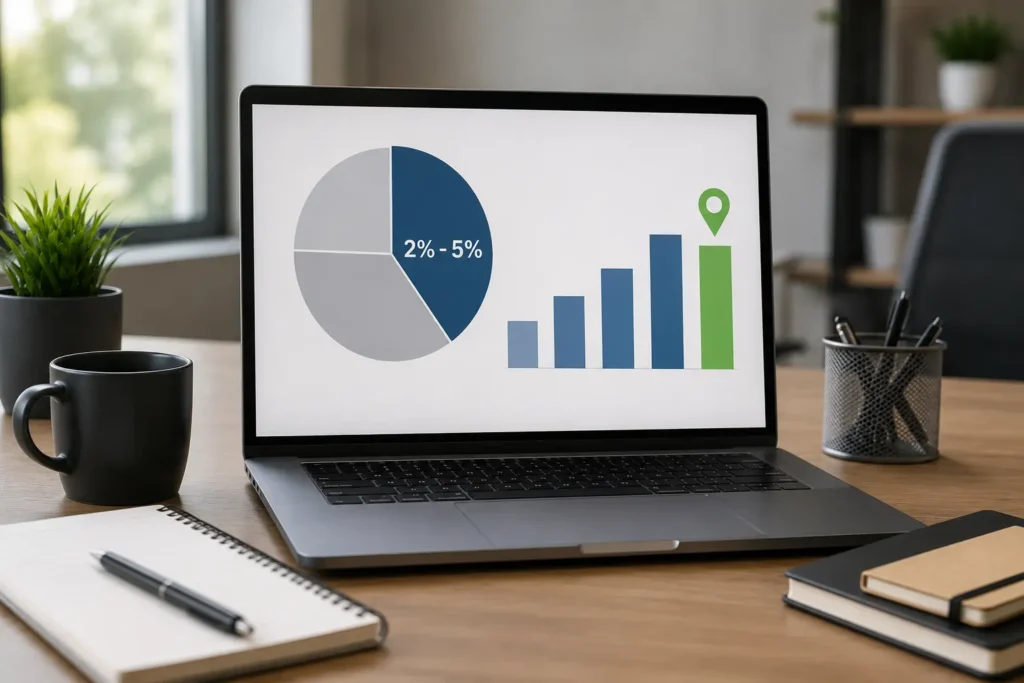
Well, that rate sits between 2% and 5% for most industries, though local service businesses in Brisbane often see closer to 3% to 5%.
That range also shifts depending on your industry, so here is how the benchmarks break down:
Industry | Average Conversion Rate |
Local services | 3% – 5% |
Ecommerce | 2% – 3% |
B2B | 1% – 2% |
SaaS / Software | 3% – 5% |
These numbers come from average conversion rates by industry, and they give you a real baseline to work from. A rate below your industry average means you’re leaving leads on the table every day (aim higher, because your competitors already are). Even a 1% improvement eventually compounds when your traffic stays consistent.
Conversion rate optimisation starts with your website because that’s where every visitor makes their decision.
Google Ads and SEO do their job of bringing people in. Your website is what convinces them to stay and act. And honestly, that second part is where most businesses fall short (a new campaign won’t fix a broken website).
So before looking at your ad spend or SEO strategy, take a look at what’s happening on the site itself.
That said, these aren’t big rebuilds. Most of the time, a targeted fix in any of these three areas noticeably improves your conversion rate.

A lot of website owners jump straight into redesigns without defining what success looks like. That’s a problem, because you can’t measure progress on a target you haven’t set.
And that target is your conversion goal. They’re the specific actions you want site visitors to take on your web pages, things like filling out a contact form, calling your number, or requesting a quote. Each one gives you a direct, measurable signal tied to real leads and revenue.
Setting the goal is only half of it. You also need to know if visitors are reaching it, and tracking gives you that answer. Once your goals are live, you can see which pages are working and which ones need attention.
In our experience building sites for Brisbane businesses, the ones that set up conversion tracking in Google Analytics from day one improve the fastest. You can see where users drop off, which tells you where to focus first.
Most visitors size up your page within a few seconds, and your design is what tips that decision. A poorly structured page is like a disorganised salesperson. There’s no clear message, no obvious next step, and the visitor starts wondering if this business is even worth their time.
Two areas of your conversion web design have the most direct impact on that:
As we’ve mentioned before, conversion-focused web design arranges every element on your landing pages and product pages to guide visitors toward one specific action. A clear headline pulls them in, and a logical page flow keeps them moving.
For a service page, that’s a headline, service description, trust signals, and a contact form, in that order.
Research shows that poor usability and cluttered website navigation are among the top reasons users abandon pages without converting. And slow load times compound that further by cutting into your conversion rate before a visitor even sees your offer.
Trust is the next hurdle. New users arrive with questions such as “Can I trust this business?” and “Are they legit?” Customer testimonials, security badges, and social proof answer those questions before visitors even scroll.
After reviewing local service websites across South East Queensland, pages with a testimonial above the fold regularly outperformed those without one. Put simply, trust elements do the selling before your copy even gets a chance.

Your call-to-action is one of the fastest lead-generation tools you already own. Even visitors who are ready to enquire will leave if your page doesn’t give them a clear next step.
Most high-converting CTAs have three things in common:
A well-placed, specific CTA is one of the few changes you can make today. The impact on your lead numbers is usually immediate (in fact, personalised CTAs convert 202% better).
A/B testing is when you compare two versions of a page to see which one performs better. It’s the most reliable way to find out what’s stopping your visitors from converting. And every change you make before you run tests is a guess at best.
Two practical areas cover most of what you need to know:
Headlines, CTAs, and page layout are the three most common starting points. A small headline change can shift your conversion rate noticeably. Your CTA carries that same weight, so both are worth testing before you touch anything else on the page.
From there, user testing and user feedback show why visitors aren’t completing the desired action. Session recordings narrow it down further, showing where they eventually drop off.
Data analysis tells you which version won, while user behaviour tells you why. And user behaviour is the part most people skip. In fact, we’ve worked with Brisbane businesses where a single headline change moved their enquiry rate within days.
So consistent testing is how you improve conversion rates steadily, without spending more on traffic.
Your website receives visitors every day. The real question is how many of them are leaving without taking any action, and what that’s costing your business in lost leads. Most of those losses come from a handful of fixable problems.
This article covered benchmarks, conversion goals, web design, calls to action, and A/B testing. Together, they give you a clear picture of where your leads are coming from and where they’re slipping away.
So if you’re ready to take immediate action on that, our team at DevelopersDex works with Brisbane businesses to build fully optimised, conversion-focused websites. We’ll take you through every step you need to improve your conversion rate and generate more leads from the same traffic.
Company Reviews